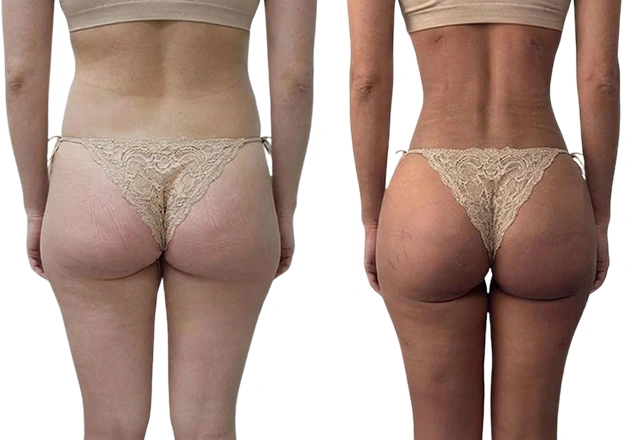
Let’s deal with the elephant in the room.
When most people hear that a snatched waist involves the ribs, their brain jumps straight to a grisly image: a surgeon cutting someone open and lifting out a couple of ribs like spare parts. It’s the version that gets passed around. It’s also completely outdated.
There are genuinely two different things here, separated by about forty years of surgical progress, and confusing them is the single biggest reason people talk themselves out of a procedure they’d actually love the result of. So here’s the honest comparison.
The old way: rib removal
Rib removal, historically called rib resection, is exactly what it sounds like. Through open incisions, a surgeon physically takes out the lowest ribs to narrow the waist. It was the only option for a long time, and it carries the baggage you’d expect from that kind of operation: real cuts, real scars, longer recovery, and a higher risk profile because you’re working with open access near the kidneys and lungs.
It works. But it’s a big, irreversible intervention, and the scars and downtime are a lot.
The snatched waist way: reshaping, not removing
A snatched waist takes a completely different route.
Nothing is removed. The lower ribs stay where they are. The surgeon uses ultrasound to map the area precisely, works through an entry point the width of a fine 1.27mm needle, and uses a piezotome (a high-frequency ultrasonic instrument) to gently and temporarily soften only the outer surface of those lower ribs. With that outer face eased, the ribs can be reshaped and guided inward with great accuracy, then left to settle in their new, slimmer position.
Instead of incisions, there’s a needle-fine access point. Instead of a scar you’ll see in the mirror for life, there are tiny access-point marks that typically fade. Instead of weeks flat on your back, recovery is built around a compression garment and a fairly gentle return to normal life.
Same goal, a narrower waist. Wildly different experience.
What the safety numbers actually say
This is where the modern method really pulls ahead, and we’d rather show you data than just reassure you.
The largest dataset we have is the 2026 global survey in Plastic and Reconstructive Surgery, Global Open, covering 2,351 patients. Across all of those cases, the overall complication rate was 3.7 percent, the serious-complication rate was 0.17 percent, and the complications that did occur were overwhelmingly minor. To put that in context, the serious-complication rate here sits well below the figures published for the most common cosmetic surgeries. Liposuction, often described as minor, carries an overall complication rate of about 2.62 percent across a meta-analysis of more than 29,000 patients. Rhinoplasty sees roughly 7.9 percent of patients have a complication and nearly 10 percent need revision surgery. Breast augmentation runs even higher over time, with around 11.7 percent of women needing a second operation within seven years. Against that backdrop, the snatched waist’s serious-complication profile is genuinely one of the lowest in the field.
A separate 2025 meta-analysis in Aesthetic Plastic Surgery backed up the safety picture, finding skin issues under one percent in the controlled studies and asymmetry around 1.85 percent.
And because people always ask about breathing, a dedicated study of 294 patients measured lung function before the procedure and again at six months and one year. There was no meaningful change. The lower ribs sit below the protective cage around your lungs rather than forming part of it, which is precisely why reshaping them leaves your breathing alone. We’ve got a whole article on the breathing question if that’s your main worry.
So why does the scary version still dominate?
Honestly? Because “woman has ribs removed for tiny waist” is a better headline than “woman has lower ribs gently reshaped through a needle-fine access point.” Fear travels faster than nuance.
But you’re reading the nuance now. A snatched waist isn’t rib removal with a softer name. It’s a genuinely different, far less invasive approach, backed by published data on thousands of patients, with a serious-complication rate below the procedures people already consider routine.
Doing it properly matters
One caveat we’ll never sugar-coat: results and safety both come down to the hands doing the work. This technique is performed well by only a small number of certified surgeons worldwide. Our Bali surgical team is internationally trained and certified in the RibXcar technique specifically, and every procedure is done in an accredited facility with full anaesthetic support. That’s not a detail. With the lower ribs, precision is the whole game.
Frequently asked questions
Does a snatched waist remove any ribs?
No. The lower ribs are reshaped and repositioned, never removed.
Is reshaping safer than removal?
The published data is strong, and the serious-complication rate (0.17 percent) sits below those of liposuction, rhinoplasty and breast augmentation.
Will rib removal give a more dramatic result?
Not necessarily, and it comes with scars, longer recovery and higher risk. Reshaping delivers a tailored result of roughly 5 to 17 centimetres with far less downtime.
Can the reshaping be reversed?
The ribs settle into their new position over the healing period. This is a lasting change, which is rather the point.